
What Writing 52 Blogs Taught Me About Business, Learning and Coaching
18 January 2026Why true sustainability means balancing profit, people, and the planet; and how getting it right builds resilience in uncertain times.
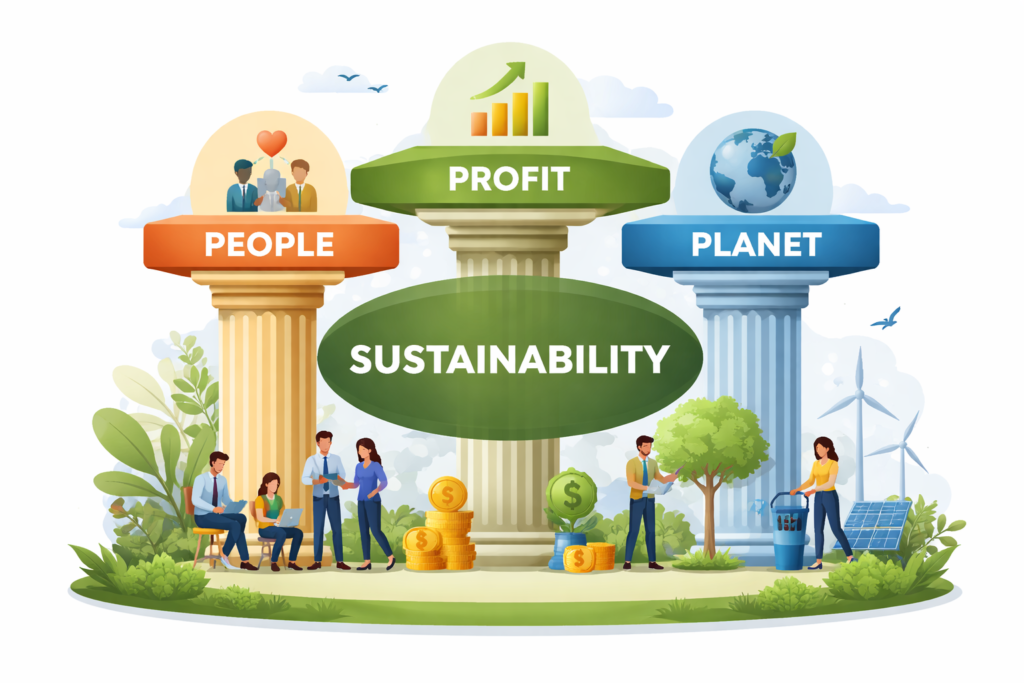
Sustainability has become one of those words everyone uses, and not always in the same way.
For many, it still brings to mind recycling bins, carbon footprints, and renewable energy. Environmental responsibility is, of course, a vital piece of the puzzle. But in today’s climate of economic uncertainty, social complexity, and increasing operational pressure, that narrow definition simply isn’t enough.
If businesses are to survive and thrive, sustainability must be understood more holistically. It is not just about protecting the planet; it is about protecting the business itself and the people within it.
True sustainability rests on three interconnected pillars: environmental responsibility, economic resilience, and staff wellbeing.
Beyond “green”: a broader definition
Environmental sustainability focuses on reducing harm to the planet, minimising waste, lowering emissions, and using resources responsibly. This remains critical, not just ethically but increasingly commercially, as customers, investors, and regulators demand meaningful action.
However, a business that is environmentally responsible but financially unstable is not sustainable. Equally, a profitable organisation that burns through its workforce is also unsustainable.
Long-term success depends on balance across all three areas.
Think of sustainability less as a checklist and more as a system. If one part weakens, the whole structure is at risk.
Economic sustainability: surviving and adapting
Economic sustainability is about more than making a profit. It is about building a business that can withstand shocks, adapt to change, and continue delivering value over time.
In periods of instability, this becomes critical. Rising costs, shifting markets, and uncertain demand make short-term thinking tempting. Cutting corners, reducing investment in people, or chasing quick wins may provide temporary relief, but often at the expense of long-term resilience.
Sustainable businesses take a different approach. They:
- Build financial resilience through planning and diversification
- Invest in efficiency rather than simply cutting costs
- Focus on long-term value over short-term gains
- Maintain strong relationships with customers and suppliers
Economic sustainability also includes pricing strategy, cash flow management, and the ability to pivot when circumstances change. It is about creating a business model that can endure, not just survive the next quarter.
Staff sustainability: the overlooked pillar
Perhaps the most underestimated aspect of sustainability is staff wellbeing, what we might call “staff sustainability.”
Employees are not an infinite resource. Yet many organisations still operate as if they are, treating people as a cost rather than the asset they truly are. High workloads, constant pressure, and lack of support lead to burnout, disengagement, and high staff turnover.
The cost is significant, not just financially, but culturally. The costs of recruitment, onboarding, and lost productivity all add up. More importantly, valuable knowledge and experience walk out the door.
Can your business afford that?
In contrast, organisations that prioritise staff sustainability recognise that their people are central to long-term success. They focus on:
- Manageable workloads and realistic expectations
- Mental health and wellbeing support
- Flexibility and autonomy where possible
- Ongoing development and growth
- Inclusive, supportive cultures
Reducing staff churn is not a “nice to have,” it is a strategic advantage. Stable, engaged teams are more productive, more innovative, and better equipped to navigate change.
The connection between the three pillars
The real power of this broader definition lies in how these elements interact.
Investing in staff wellbeing improves productivity and reduces costly turnover, strengthening economic sustainability. Improving efficiency to reduce environmental impact often lowers costs and reduces pressure on teams.
Neglect, on the other hand, has a ripple effect. Financial pressure can lead to decisions that damage morale. Poor well-being reduces performance and profitability. Ignoring environmental responsibility can harm reputation and erode trust.
Sustainability is not about trade-offs; it is about alignment.
Why this matters more now than ever
In uncertain times, businesses often shift into survival mode. While understandable, this can lead to decisions that weaken long-term sustainability.
Cutting training budgets, increasing workloads, or delaying investment might ease immediate pressure, but often create bigger problems later. Burnout rises, performance drops, and resilience declines.
At the same time, expectations are increasing. Customers are more values-driven. Employees are less willing to tolerate poor conditions. Investors are paying closer attention to long-term viability.
This presents both a challenge and an opportunity.
Businesses that embrace a broader, more balanced approach to sustainability can stand out, not just as responsible, but as resilient and forward-thinking.
Practical steps towards holistic sustainability
This shift does not require a complete overhaul overnight. Small, intentional changes can have a meaningful impact.
Start by asking three questions:
- Environmental: Where can we reduce waste or resource use without compromising quality?
- Economic: Are our decisions building resilience? Or just relieving short-term pressure?
- Staff: Are our people able to sustain their performance, or are we pushing them towards burnout?
Then look for overlap, changes that support more than one pillar:
- Flexible working can improve wellbeing and reduce overheads
- Streamlined processes can cut waste and increase efficiency
- Investment in training can boost engagement and productivity
Crucially, involve your team. They often have the clearest insight into what is, and isn’t, working.
A shift in mindset
Redefining sustainability ultimately requires a shift in mindset.
It moves the conversation away from compliance, “What do we have to do?” towards strategy, “What kind of business do we want to be?”
A sustainable business is not one that simply minimises harm. It is one designed to endure, adapt, support its people, manage its resources wisely, and build for the future.
The long view
Sustainability, in its fullest sense, is about longevity.
It asks whether a business can continue to operate effectively, not just this year, but in five, ten, or twenty years’ time.
That requires more than environmental awareness. It demands financial stability and a workforce that is supported, engaged, and able to thrive.
In economically unstable times, this broader definition is not a luxury; it is essential.
Because the businesses that succeed will not be those that cut the deepest or move the fastest in the short term. They will be the ones that build strong, balanced foundations and make decisions with the long view in mind.
That is what sustainability really means.
Because sustainable businesses don’t just last, they work better for everyone involved.
CTA
Take a moment to assess your business across all three pillars: environmental, economic, and staff wellbeing.
Where is the imbalance? What’s one step you can take this month to address it?
#HaywardHub #BuildingBetterBusiness